Measured: 2 hours ago (11/17/2026)
I took a masterclass with Billy Strings' teacher. Here's his killer scale exercise.
YouTube Video · Fret Science · 26 October 2026
Fret Science (US) · educator
Mathematical and geometric approach to visualizing intervals, scales and symmetry across the guitar neck
Video transcriptauto-generated captions · EN · RU
Click a timecode to jump to that moment in the video
This is a scale exercise I learned from Billy Strings' teacher. Back in August, I drove to Tennessee for a guitar camp, and I sat in on a fretboard geometry masterclass taught by Rob Kappelletto. Rob has been Billy's teacher for
Это масштабное упражнение, которое я узнал от учителя Билли Стрингса. В августе я поехал в Теннесси на гитарный лагерь, и я сидел на мастер-классе по геометрии fretboard, который преподавал Роб Каппеллетто. Роб был учителем Билли.
the last few years, and he's currently also working with Andy Wood, both of whom are phenomenally good guitar players. In the class, Rob presented a scale exercise that covers the whole fretboard with six shapes.
Последние несколько лет, и в настоящее время он также работает с Энди Вудом. Оба они феноменально хорошие гитаристы. В классе Роб представил масштабное упражнение, которое охватывает весь fretboard с Шесть форм. Это довольно просто описать, но это немного сложно сделать.
It's pretty simple to describe, but it's a little bit challenging to do, and it's the kind of exercise I'd happily assign to one of my own students. So, first I'm going to teach it to you the way Rob laid it out with one small
И это то упражнение, которое я с радостью назначу одному из своих учеников. Итак, сначала я научу его тебе так, как Роб выложил это с одним маленьким. Добавка, которую я укажу по пути. И если это все, за чем вы пришли, первая главная глава этого видео - вся
addition of my own that I'll point out along the way. And if that's all you came for, the first main chapter of this video is the whole routine, and you can stop there. Everything after that is my take on it.
рутина, и вы можете остановиться на этом. Все после этого - мой взгляд на это. Потому что, проработав это, я думаю, у него есть несколько важных ограничений, которые Поначалу это не очевидно. Но мы перейдем к этому во второй половине видео,
Because after working through it, I think it has a few important limitations that aren't obvious at first. But we'll get to that in the second half of the video, where I'll show you a more general way to build the same shapes that gives you a lot
где я покажу вам более общий способ создания тех же форм, которые дают вам много Больше гибкости, когда дело доходит до игры на протяжении всего fretboard. Если ты здесь новенький, добро пожаловать. Я Кит, я играю на гитаре около 40 лет.
more flexibility when it comes to playing over the entire fretboard. If you're new here, welcome. I'm Keith. I've been playing guitar for about 40 years, and I've spent the last few years looking at the fretboard through a computer
и я провел последние несколько лет, глядя на fretboard через компьютер Научная линза, нахождение шаблонов, которые позволяют вам понять это, а не просто Хорошо, начнём с упражнения.
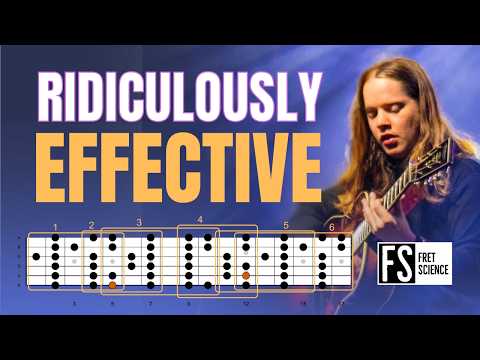
science lens, finding the patterns that let you understand it instead of just memorizing it. All right, let's start with the exercise. As we go, the fretboard you saw at the bottom of the screen will show every note I play along with how I'm visualizing the patterns.
По мере того, как мы идем, fretboard, который вы видели в нижней части экрана, покажет каждую ноту I Играй вместе с тем, как я Визуализация шаблонов. Сначала вы выбираете ключ. Роб предложил работать по одному ключу в день, вращаясь вокруг цикла пятых, 12 дней покроют все.
First, you pick a key. Rob suggested working in one key per day, moving around the cycle of fifths, so 12 days would cover everything. For each key, you play the major scale in six positions, starting with the lowest one on the neck and working your way up.
Для каждого ключа вы играете в масштабе на шести позициях, Начинается с самого низкого на шее и поднимается вверх. В ключе А первые три позиции имеют корень на пятом ладе Низкая строка E. В первом случае корень находится под вашим мизинцем.
In the key of A, the first three positions have the root at the fifth fret of the low E string. In the first one, the root is under your little finger. Rob called this playing behind the root because the whole position sits below it.
Роб назвал это игрой за корнем, потому что вся позиция сидит ниже Это. После крупного масштаба вы играете главную пентатонику в том же самом позиция. Затем вы играете главный triad arpeggio.
After the major scale, you play the major pentatonic in the same position. Then you play the major triad arpeggio. Next you shift up so the root is under your middle finger and your hand is straddling the root.
Затем вы переместите вверх, так что корень находится под вашим средним пальцем и ваша рука будет Прилегает к корню. Тогда ты играешь в пентатоник Форма. arpeggio.
Then you play the pentatonic shape. And the arpeggio. Next we play in front of the root. This time with a three notes per string shape and with your index finger on the root.
Далее мы играем перед корнем. На этот раз с тремя нотами в форме строки и с указательным пальцем на root.
With this shape, Rob didn't include the pentatonic scale or the arpeggio, but we can add both with a diagonal pentatonic shape. That's my small addition.
С этой формой Роб не включал пентатоническую шкалу или arpeggio, но мы можем добавить оба с диагональной пентатонической формой. Это мое небольшое дополнение.
Then we apply the same idea with the root on the A string. In A, that's the 12th fret. First behind the root.
Затем мы применяем ту же идею с корнем на строке А. В "А" это 12-й лад. Первый за root.
Then straddling the root. Then three notes per string in front of the root.
Затем спрятать корень. Затем три ноты на строку перед корнем.
And again, we can add the diagonal pentatonic and the arpeggio.
И снова мы можем добавить диагональный пентатонический и arpeggio.
So, that's the routine. You play the major scale, the major pentatonic, and the major triad arpeggio in six positions that completely cover the fretboard. That's 18 shapes per day, one key a day for 12 days, and then you start over. So, that's Rob's exercise.
Такова рутина. Вы играете в мажорном масштабе, главном пентатонике, и основной triad arpeggio в шести позициях, которые полностью покрывают fretboard. Это 18 форм в день, по одному ключу в день в течение 12 дней. А потом ты начинаешь все сначала. Это упражнение Роба.
And if you stop here, you have all of it. From here on, I'm going to show you my take on this approach to scales. Memorizing patterns like these can get you a long way, but it has some built-in limitations.
И если вы остановитесь здесь, у вас есть все это. С этого момента я покажу вам свой подход к шкалам. Запоминание таких шаблонов может принести вам долгий путь, Но у него есть некоторые встроенные ограничения. Я покажу вам способ создания тех же форм на лету, которые работают с
I'm going to show you a way of building the same shapes on the fly that works from any root location on the fretboard and for more than just the major scale. One really cool thing about Rob's exercise is that it mixes two systems that usually get taught separately.
любое местоположение корня на fretboard и для большего, чем просто основной масштаб. Одна действительно крутая вещь в упражнении Роба заключается в том, что оно смешивает две системы, которые обычно Учиться отдельно. Формы в положении из системы caged и три ноты на строку.
The in-position shapes from the caged system and three notes per string patterns. On the low E string, behind the root is the G shape, and straddling the root is the E shape. On the A string, behind the root is the C shape, and straddling it is the A shape.
На нижнем струне E, за корнем - форма G, И корень - это форма Е. На струне А, за корнем - форма С, И, конечно же, это форма А. Единственным недостающим является форма D, имеет свои корни на D и B струнах.
The only one missing is the D shape, which has its roots on the D and B strings. It doesn't fit with Rob's exercise because the root isn't on one of the bottom two strings. And that's true for the scale, the pentatonic, and the arpeggio.
Это не соответствует упражнению Роба, потому что корень не на одном из двух нижних. И это верно для масштаба, Pentatonic и arpeggio. Это отличная основа, но это все еще набор шаблонов для запоминания. И запоминание шаблонов имеет некоторые пределы, о которых стоит знать.
So, it's a great foundation, but it's still a set of patterns to memorize. And memorizing patterns has some limits that are worth knowing about. First, there are a lot of them. For the major scale alone, that's 18 shapes you'd have to memorize.
Во-первых, их очень много. Только для крупного масштаба это 18 форм, которые вы должны запомнить. Они подвижны, так что те же 18 работают в каждом ключе. Но это еще многое нужно держать в голове. И мы еще не коснулись ни одной другой чешуи. Во-вторых, много дублирования.
They're movable, so the same 18 work in every key, but that's still a lot to hold in your head. And we haven't touched any other scales yet. Second, there's a lot of duplication. Any of these major scale patterns can also be used to play the other six major scale
Любой из этих основных шаблонов масштаба также может быть использован для воспроизведения других шести крупных масштабов. режимы. Формы для A major имеют точно такие же ноты, как B Dorian, Например, D Lydian.
modes. The shapes for A major have exactly the same notes as B Dorian, for example, or D Lydian. The only thing that changes is which note inside the shape is treated as the root. So, to get seven modes out of one pattern,
Единственное, что меняется, это то, какая нота внутри формы рассматривается как корень. Итак, чтобы получить семь режимов из одного шаблона, Вы также должны запомнить, где корни каждого режима находятся внутри него.
you also have to memorize where each mode's roots sit inside it. Going that way, you can end up with dozens of patterns to keep track of. Third, patterns like these are usually anchored to a root on the low E or A string.
Идя таким образом, вы можете получить десятки шаблонов для отслеживания. В-третьих, такие шаблоны обычно привязываются к корню на нижнем E или A строке. Но когда ты соло, ты обычно на первых четырех струнах. Скажем, вы играете за аккорд,
But when you're soloing, you're usually up on the top four strings. So, say you're playing over an A chord, and the A you're aiming for is at the 10th fret of the B string. To use these shapes, you'd have to find an A down on one of the bottom two strings,
А, к которому ты стремишься, находится на десятом ладе струны В. Чтобы использовать эти формы, нужно найти букву "А" на одной из нижних двух струн. Выясните, в какой форме вы находитесь, а затем вернитесь. Вы можете сделать это, и это становится быстрее с практикой.
work out which shape you're in, and then come back up. You can do that, and it gets faster with practice, but it adds steps when you're in the middle of a solo. Fourth, these patterns are pictures of a six-string guitar in standard tuning.
Но он добавляет шаги, когда вы находитесь в середине соло. В-четвертых, эти узоры представляют собой изображения шестиструнной гитары в стандартной настройке. Добавьте седьмую струну или возьмите пятиструнный бас, Вам нужны совершенно другие фотографии.
Add a seventh string or pick up a five-string bass, and you need entirely different pictures. Now, none of that is a reason to skip Rob's exercise. But it would be even better if we had a solution that would work for every mode, and for any root we can find on the fretboard,
Ничто из этого не является причиной пропустить упражнения Роба. Но было бы еще лучше, если бы у нас было решение, которое работало бы для каждого режима. и для любого корня мы можем найти на fretboard,
and that we could use on a guitar with any number of strings and standard tuning, or on a bass. And the good news is that that is entirely possible. To do it, we need a few simple building blocks. I'm going to give you a high-level overview of them here,
и что мы могли бы использовать на гитаре с любым количеством струн и стандартной настройкой, или на басу. Хорошая новость заключается в том, что это вполне возможно. Для этого нам нужно несколько простых строительных блоков. Я собираюсь дать вам обзор на высоком уровне здесь,
but this video would be more than an hour long if I covered everything in depth. So, if you want more detail on any of these pieces, I'll link to videos that go deeper on each one. First, we need to understand the tuning quirk between the G and B strings in standard tuning.
Но это видео длилось бы больше часа, если бы я все подробно осветил. Так что, если вы хотите больше деталей на любой из этих частей, Я буду ссылаться на видео, которые будут глубже в каждом из них. Во-первых, нам нужно понять причудливость настройки между строками G и B в
That pair of strings is tuned a major third apart, while every other pair of strings is tuned a fourth apart. What that means is that if we take any geometric pattern from an all-fourths fretboard and lay it across the G and B strings,
Стандартная настройка. Эта пара струн настроена на большую треть, В то время как каждая другая пара струн настроена на четвертую часть. Это означает, что если мы возьмем любой геометрический рисунок из всех четвертей fretboard и положите его через строки G и B,
the upper part of the pattern shifts one fret toward the bridge. I call this the warp, and I have a full [clears throat] video about it. In my diagrams, I draw the warp as a dashed line between the G and B strings with an arrow that shows which way the shift goes.
Верхняя часть рисунка смещается на одну лапу к мосту. Я называю это варп, и у меня есть полное видео об этом. На моих диаграммах я рисую варп как пунктирную линию между строками G и B с помощью Стрелка, которая показывает, в какую сторону идет сдвиг.
Second, we need the right building blocks. On an all-fourths fretboard, the pentatonic scale is a repeating five-string pattern with two notes on every string. I break it up into two smaller shapes that I call the rectangle and the stack.
Во-вторых, нужны правильные строительные блоки. На всех четвертых fretboard пентатоническая шкала представляет собой повторяющийся пятиструнный шаблон. с двумя нотами на каждой строке. Я разбиваю его на две более мелкие формы, которые я называю прямоугольником и стеком.
Every pentatonic fingering pattern is built out of rectangles and stacks, alternating as you go across the strings and shifting as they cross the warp. I have a full video on this, too, but if it's unfamiliar, just hang on for now. Because every string has exactly two notes,
Каждый пентатонический рисунок пальцев построен из прямоугольников и стеков, попеременно, когда вы идете через струны и сдвигаетесь, как они пересекают варп. У меня тоже есть полное видео об этом, но если это незнакомо, Просто держись пока.
any root you find is either the lower note on its string or the higher one. For this video, I'll call those the low root and the high root. In the major pentatonic, a high root is always the highest note of a rectangle,
Потому что каждая строка имеет ровно две ноты, Любой корень, который вы найдете, является либо нижней нотой на его строке, либо более высокой. Для этого видео я назову их низшим корнем и высоким корнем.
and a low root is always the lower note on the top string of a stack. So, whichever one you've got, you know which shape to snap onto it, and you can alternate rectangles and stacks out from there. Inside each rectangle and each stack, we can find a full major triad.
В главном пентатонике высокий корень всегда является самой высокой нотой прямоугольника. и низкий корень - это всегда нижняя нота в верхней строке стека. Итак, какой бы у тебя ни был, ты знаешь, какую форму на него прикрепить.
So, our in-position triad arpeggios are easy to recreate. And to turn the pentatonic scale into the major scale, we just add two notes inside the rectangle and two notes around the stack. That gives us the exact in-position scale fingerings that are taught in music books,
и вы можете чередовать прямоугольники и стеки оттуда. Внутри каждого прямоугольника и каждой стопки, Мы можем найти полный крупный triad. Таким образом, наши встроенные арпеджио triad легко воссоздать. И превратить пентатоническую шкалу в крупный масштаб,
which are the ones Rob uses in his exercise. One other helpful thing to know is that stacks connect diagonally since their lowest and highest notes are an octave apart. So, if you know where the root is inside each of the shapes, you can build out a pentatonic scale,
мы просто добавляем две ноты внутри прямоугольника и две заметки вокруг стека. Это дает нам точные масштабные пальчики, которые преподаются в музыкальных книгах. Которые Роб использует в своих упражнениях.
an arpeggio, or a major scale from any root you can find anywhere on the fretboard, even on a five-string bass or eight-string guitar. The third thing we need is a better way to see the three notes per string patterns.
Еще одна полезная вещь, которую нужно знать, это то, что стеки соединяются по диагонали с самого низкого уровня. А самые высокие ноты находятся на расстоянии октавы. Итак, если вы знаете, где корень находится внутри каждой формы, Вы можете построить пентатоническую шкалу,
Every three-notes per string pattern is made up of three-note fragments, and there are only three of them. Uh whole step with a whole step, a whole step with a half step, and a half step with a whole step. On an all-fourths fretboard, they make a repeating pattern.
arpeggio или крупный масштаб из любого корня, который вы можете найти в любом месте на fretboard, Даже на пятиструнной басовой или восьмиструнной гитаре. Третье, что нам нужно, это лучший способ увидеть три ноты на строку.
Three whole-whole fragments, then two half-whole, then two whole-half, and then it repeats. There's one tiny wrinkle, which is that going up when you move from the last whole-whole fragment to the first half-whole one, the pattern shifts one fret toward the bridge.
Каждые три ноты на струнный рисунок состоят из трехнотных фрагментов, И их всего три. Целый шаг, целый шаг с половиной шага. Половина шага с целым шагом. На всех четвертых fretboard они делают повторяющийся шаблон. Три целых фрагмента, затем два полуцелых,
And on a real guitar, the warp adds its own one-fret shift between the G and B strings just like it does for everything else. To play the major scale starting with your index finger on the root, you start on the middle whole-whole fragment and work out from there.
Затем два полных, а потом повторяется. Есть одна крошечная морщинка, которая поднимается, когда вы двигаетесь от последней. Полный фрагмент до первого полуцелого, Узор смещается на одну лапу к мосту.
I've a whole video on this as well. Now, let's put these pieces together and run Rob's exercise again in a new key. This time, I'll show you what I'm seeing as I play. Let's do it in D this time. In D, the root on the A string is lower on the neck than the root on the E string.
А на настоящей гитаре варп добавляет свой собственный однофретовый сдвиг между G и B струны так же, как и все остальное. Чтобы играть главную шкалу, начиная с указательного пальца на корне, Вы начинаете с среднего целого фрагмента и работаете оттуда.
So, this time the A string shapes come first. When we play behind the root, the D is the high note on the A string, so it's the top of a rectangle. I alternate rectangles and stacks up from there, add the two notes, and that's the scale.
У меня тоже есть видео на эту тему. Теперь давайте сложим эти части вместе и проведем упражнение Роба в новом ключе. На этот раз я покажу вам, что вижу во время игры. Давайте сделаем это в D на этот раз. В D корень на строке A ниже на шее, чем корень на струне E.
The pentatonic is just the rectangles and stacks. And the triad is sitting inside them. Now, when we straddle the root, the D is the low note on its string, so it's on the top string of a stack.
Итак, на этот раз струны А стоят на первом месте. Когда мы играем за корнем, D - это высокая нота на струне А. Так что это вершина прямоугольника. Я перевожу прямоугольники и стекаю оттуда, Добавьте две ноты, и это Масштаб.
In front of the root, we use three notes per string. My index finger is on the root of the major scale, so it's the middle whole-whole fragment.
Pentatonic - это просто прямоугольники и стопки. И triad сидит внутри их. Теперь, когда мы оседлаем корень, D - это низкая нота на его струне, Так что он на верхней строчке стека.
And the diagonal pentatonic built from the same rectangles in the stacks.
Перед корнем мы используем три ноты на строку. Мой указательный палец на корне большой шкалы, так что это среднее целое Фрагмент.
And the arpeggio inside the diagonal pentatonic. Now, the E string at the 10th fret. First, behind the root.
И диагональная пентатоника построена из тех же прямоугольников в Стеков.
Then, straddling. And now, in front of the root with three notes per string.
И arpeggio внутри диагонали Пентатоник. Теперь струна Е на 10-м ладе. Во-первых, за root.
Now let's do something the original exercise can't. Here's the D on the 15th fret of the B string where a lot of soloing happens. It's the high note on its string, so it's the top of a rectangle. And when I build out from there, I get the D shape, the one that was missing.
Тогда, трансграничной. А теперь, перед корнем с тремя нотами на струну.
So I just played in seven different positions with nothing memorized except two shapes, three fragments, and the warp. And this approach can do something that the original exercise can't. We can use it to build five more of the major scale modes.
Теперь давайте сделаем то, что оригинальное упражнение не может. Вот D на 15-м ладе струны B, где много соло случается. Это высокая нота на струне, так что это вершина прямоугольника. И когда я строю оттуда, я получаю форму D, Тот, который пропал.
Five, not six, because the Locrian mode doesn't have a major or minor pentatonic scale or triad inside it build around. That's okay because Locrian is barely used at all in real music. To do this, you need to understand what I call brightness ordering.
Так что я просто играл в семи разных позициях, ничего не запоминал, кроме двух. Формы, три фрагмента и варп. И этот подход может сделать то, чего оригинальное упражнение не может. Мы можем использовать его для создания еще пяти основных режимов масштаба.
Where the minor pentatonic roots sit inside the rectangle and stack, and how the two added notes move for each mode. I have detailed videos on all of this. And for three notes per string, we need to know which starting pattern goes with
Пять, а не шесть, потому что режим Locrian не имеет большой или малой пентатонической системы. масштаб или triad внутри он строит вокруг. Это нормально, потому что Locrian почти не используется в реальной музыке. Для этого вам нужно понять, что я называю упорядочением яркости.
which mode. But if we wanted to do a Dorian version of Rob's exercise, we could. Here it is in A Dorian.
Где мелкие пентатонические корни сидят внутри прямоугольника и стека, и как две добавленные ноты движутся для каждого режима. У меня есть подробные видео обо всем этом. И для трех нот на строку нам нужно знать, с какой исходной схемой идет
Notice that there's no straddling shape this time. On both strings, the low root shape puts your index finger right on the root, just like the three notes per string shape does. So, Rob's way of naming the shapes doesn't quite fit Dorian,
какой режим. Но если мы хотим сделать Dorian-версию упражнения Роба, Мы могли бы. Вот он в A Dorian.
but the building blocks handle it without any extra rules. Most of what I've talked about in this video is covered by the first 12 YouTube videos I ever made. If you watch them in the recommended order, it's like a free mini course.
Обратите внимание, что в этот раз нет трансграничной формы. На обеих струнах низкая форма корня ставит ваш указательный палец прямо на корень, Так же, как и три ноты в форме струны. Так что, способ Роба назвать формы не совсем подходит для Dorian.
They're in a playlist called Guitar Scales Made Easy. You can also watch all 12 with no ads at fretscience.com by creating a free account. And that page has a printable PDF cheat sheet for each video in right- and left-handed editions if you'd like them on paper.
Но строительные блоки обрабатывают это без каких-либо дополнительных правил. Большая часть того, о чем я говорил в этом видео, освещается первыми 12 YouTube Видео, которые я когда-либо делал. Если вы смотрите их в рекомендованном порядке, Это как бесплатный мини-курс.
But, I've recently made a flagship course called Complete Scale Fluency that's even better. It has 44 detailed lessons, about 5 and 1/2 hours of video in all, that teach scale fluency on the guitar in a complete step-by-step way.
Они в плейлисте под названием Guitar Scales Made Easy. Вы также можете смотреть все 12 без рекламы на fretscience.com, создав бесплатную учетную запись. И на этой странице есть распечатанный PDF-лист для каждого видео в правой и Левые издания, если вы хотите их на бумаге.
It has dozens of exercises and powerful online practice tools to help with learning the fretboard and visualizing the 20 most commonly used scales and more. And it comes with a 120-page PDF course guide in both right- and left-handed editions.
Но недавно я сделал флагманский курс под названием Complete Scale Fluency, который даже лучше. Имеет 44 подробных урока, около 5 и 1/2 часов видео в целом, которые обучают беглости на гитаре в полном шаг за шагом.
The free root means you do the organizing yourself. The course does it for you, and you can get access with a one-time purchase or by subscribing to my Patreon at the gold level. Either one will get you there. And if you're a subscriber on Patreon,
Он имеет десятки упражнений и мощные инструменты онлайн-практики, чтобы помочь с обучением fretboard и визуализация 20 наиболее часто используемых весов и более. И он поставляется с 120-страничным руководством курса PDF как в правой, так и в левой руке Издания.
there's a PDF version of this lesson on fretscience.com. I want to thank Rob Kappleletto for the idea that started all this. He teaches at York University and mentors through Sonora, and based on the conversations I had with him at camp, I highly recommend him as a teacher.
Свободный корень означает, что вы делаете самоорганизацию. Курс делает это для вас, и вы можете получить доступ с разовой покупкой или Подписывайтесь на мой Patreon на золотом уровне. Любой из них доставит вас туда. И если вы подписчик на Patreon,
If this has changed how you see the fretboard at all, hit the like button and make sure you're subscribed, and you can find a lot more at fretscience.com.
Есть PDF-версия этого урока на fretscience.com. Я хочу поблагодарить Роба Каплетто за идею, которая положила начало всему этому. Он преподает в Йоркском университете и наставников через Сонору, и основываясь на разговорах, которые я имел с ним в лагере,