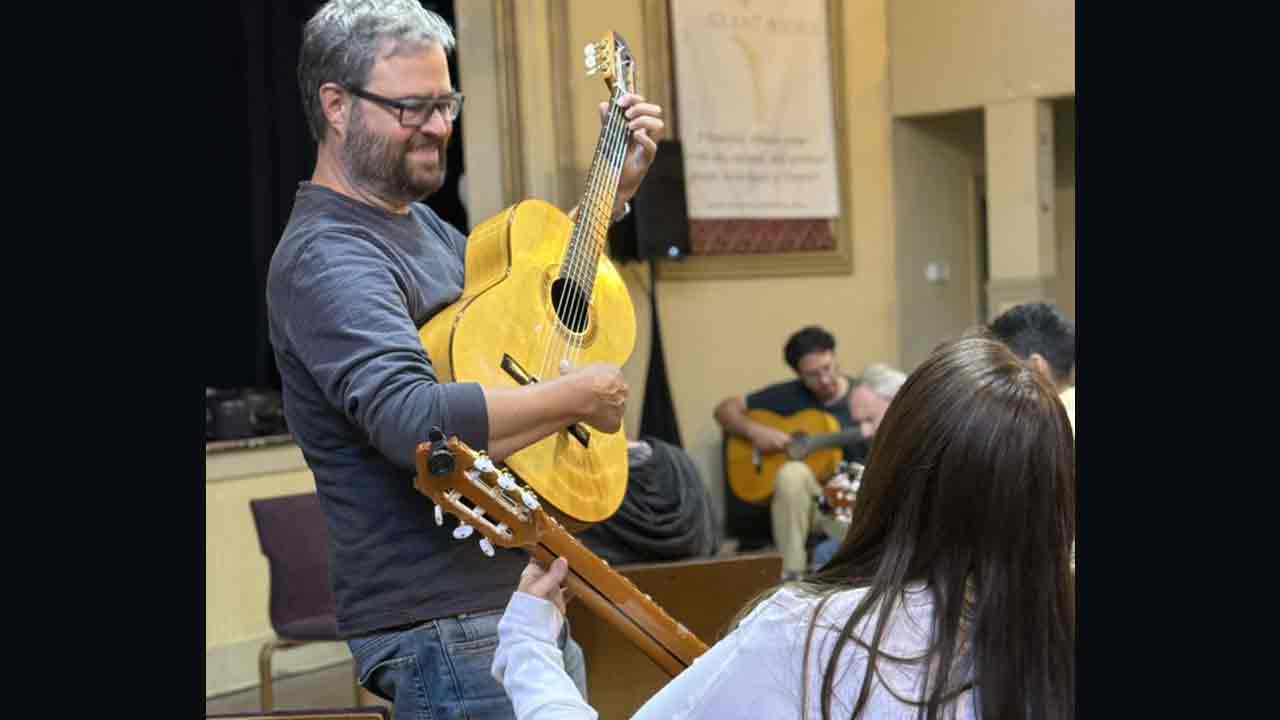
Is It Too Late For Me To Learn Flamenco?
24 June 2026 · Source: Flamenco Explained
The post Is It Too Late For Me To Learn Flamenco? appeared first on Flamenco Explained .
Is it too late for me to learn flamenco?
If you’re asking this question, you’ve probably already absorbed the myth: that flamenco is something you have to grow up with, that starting as an adult means you’re never going to truly understand it or play anything authentic. None of that is true.
Age isn’t the variable
Nobody is born with compás in their blood. Kids who grow up around flamenco hear it more, so it feels natural to them. It’s not genetic. Grow up with jazz, and jazz will be familiar. Same for Blues, Rock, Bluegrass — you name it. The better you know the music, the easier it will be to learn. So the big issue for most adult students is simply familiarity — you probably love the sound of flamenco but haven’t heard that much real flamenco. I’ve been doing this since the mid-1980s, and that’s exactly how I started: enchanted but ignorant.
Starting at 30, 40, or 60 doesn’t close anything. What you lose in years of exposure, you make up for with drive and the ability to actually understand the assignment. Turns out that matters more.
But since you have some catching up to do, you’re going to need to be more directed in your study. You’re going to need a guide to help you sort out what’s actually important and what’s just flash. (And yes, there will be flash regardless.)
What actually determines whether you’ll get good
Three things, none of which has to do with age:
An actual method that focuses on compás from the start. Most instruction teaches technique, material, and some basic compás concepts, but doesn’t properly emphasize just how important that compás is going to be as you move forward. So you learn to play with very little context. You may memorize the material and how to play it in compás, but it’s more paint-by-numbers than actually learning to paint. Compás has to be built into everything you do from the start.
Learning how flamenco actually works. It’s much easier to teach someone to memorize a piece than it is to help them understand the music itself. Unlike classical, flamenco isn’t really about playing things the same way every time. It’s about expression — which is probably what drew you to it in the first place. Learning to express yourself in flamenco is far more satisfying than memorizing a piece, but you’ll need to understand and practice how that all works. This doesn’t happen if you just memorize pieces.
Consistency, not talent. This is true of any instrument, but it matters more here because you’re not just learning technique and material — you’re learning a language. And if you don’t reinforce your technique and your compás early on, flamenco can start to feel exactly as hard as you were afraid it would be.
The real obstacle isn’t your age — it’s access to good teaching
Traditionally, flamenco gets passed down by sitting with a teacher who’s watching you closely, correcting you in real time, immersing you in the music constantly. Eventually you and your fellow students start getting together, trying things out on each other. You’re hearing flamenco all the time, so you’re not consciously decoding it — it’s getting absorbed because someone good is guiding the process and the music is just always around you.
When that works, it’s the best way to learn anything. But almost nobody has access to this.
Most of what’s available instead is the opposite of traditional transmission: material without a guide. YouTube videos, scattered courses, TABs with no context. You’re left to do alone what a good teacher would normally walk you through. That’s the actual obstacle for most adult students — not lack of talent, not starting too late, but being handed material without an understanding of how it fits together.
That’s a solvable problem. It just requires building something that does what a great teacher does — guides you, makes the implicit explicit, keeps you from getting lost — but doesn’t require you to live in Spain to get it.
Why I built Flamenco Explained around this exact problem
I didn’t start as a rock or jazz guitarist who picked up flamenco later. I was supporting myself as a gigging flamenco player before I’d ever read a note of music. I learned to play first, the way most flamenco players do.
Then, at 27, I went to Berklee and learned music theory completely from scratch — the same starting point most adult students are at when they come to me. The difference is I’d already been playing flamenco for 10 years by that point, which meant I was learning to translate: taking the vocabulary I’d just learned and using it to explain why the things I already knew how to play actually worked. That translation work — turning what I play and feel, and what I learned from the great teachers I studied with, into something I can actually explain — is the foundation of how I teach.
I’d also been rebuilt from the ground up once already. When I moved to Spain in 1992, my first teacher told me that what I was playing ‘used to be’ flamenco. I’d learned an older style that was no longer in fashion. That teacher, Juan Fernandez, tried to discourage me by saying we’d have to start from scratch if I wanted to study with him. So we started from scratch — except we didn’t, not really. The foundation I’d gotten from Dennis Koster applied to any style of flamenco. Juan updated my groove and a lot of my harmonic language, and he made me a far better player. But he never had to teach me how flamenco or compás actually worked. Dennis had already done that. The style was out of date*. The foundation wasn’t.
So when I built The Camino — Flamenco Explained’s complete six-level path from absolute beginner to advanced — the goal was specific: be the guide. Do what a great in-person teacher does — explain the why, catch what you can’t see yourself, keep compás at the center of everything — but make it available to anyone, anywhere, in English. Over 900 lessons, all built around compás from the first lesson, never as an afterthought.
So, can you learn from scratch?
Yes. The people who don’t get good aren’t the ones who started late or learned in English. They’re the ones who got technique without context and rhythm without guidance — left to figure out alone what a good teacher would normally show them. Give yourself real instruction and consistent practice, and the timeline has very little to do with where you started.
*I’m actually very glad that I learned this older style first.
More in this topic
 Flamenco, bossa nova & Latin16th Note Arpeggio Bursts - Flamenco Guitar Tutorial by Kai NarezoFlamenco Explained (YouTube)
 Flamenco, bossa nova & LatinComplete Beginner’s Guide to Learning Flamenco GuitarFlamenco Explained
 Flamenco, bossa nova & LatinTeaching Flamenco Guitar: Why Compás Comes FirstFlamenco Explained
 Flamenco, bossa nova & LatinThe Complete Guide to Flamenco Guitar ChordsThe post The Complete Guide to Flamenco Guitar Chords appeared first on Flamenco Explained .Flamenco Explained