
How To Rewire Your Brain For Jazz Guitar (Stop Overthinking)
22 October 2026 · Source: Jens Larsen — jazz guitar lessons
For most guitarists, playing jazz is as difficult as juggling chainsaws on fire. You have to keep track of notes, scales, chords, rhythm, and it is all coming at you at once! But if you ask any pro guitarist, they will tell you that they almost don’t think at all. So in this video, I […] The post How To Rewire Your Brain For Jazz Guitar (Stop Overthinking) first appeared on Jens Larsen .
For most guitarists, playing jazz is as difficult as juggling chainsaws on fire.
You have to keep track of notes, scales, chords, rhythm, and it is all coming at you at once!
But if you ask any pro guitarist, they will tell you that they almost don’t think at all.
So in this video, I will show you how to rewire your brain and think like a pro guitarist, so it is easier to play jazz without trying to keep track of every note, extension, or alteration.
Joe Pass & Wes Montgomery
Let’s start with how Joe Pass thinks of chords:
“You must look at chord changes really in the simplest for way you can look at them it don’t complicate them in your mind”
And he then goes on to simplify chords to basic 7th chords, no extensions, and even throws out some of the chords: Cm7(11) F7 just becomes F7. A lot less information. I’ll return to it later in the video.
And the jazz guitarist Joe Diorio asked Wes about soloing and got this answer:
“Wes, when you think of Dm7 G7 C, what do you think?”
He said, “Man, it’s a sound”
For now, that is still a bit mysterious, but he is clearly not thinking every note or a specific scale or arpeggio.
Let me show you how this can work using a simple lick, and then use that to talk about how and what you should practice. After that, we can get into chord progressions.
Stop Spelling Jazz Licks
Instead of thinking about every note, you need to learn jazz as a language, and part of that is learning the words in jazz.
Take a simple lick like this:
When you talk to someone, you don’t spell every word.
This looks unclear and difficult:
NOTABLETOTALK
But split into wordes it instantly makes
NOT ABLE TO TALK
In the same way, if you think of this lick as being a series of notes, it is complicated:
B C E G B Bb A Ab F# G
Nobody can think that while soloing. It doesn’t make any sense.
But if you know the words in jazz then it goes from being 10 random notes to being 2 things:
A Triplet arpeggio + Chromatic run
And that’s a lot easier. So the question is: how do you learn the words?
Your First Jazz Words
So far, we’re only looking at how you think about jazz licks, not yet how you learn to play them. But that already helps a lot: it makes it much easier to understand the solos and licks you practice.
Check out this example from Joe Pass’s Solo on Just Friends:
As soon as you know the words it becomes a much clearer jazz sentence.
I’ll break it down in a bit.
The words you want to focus on are short. Again, just like language.
Long, complicated words are less common and less useful.
You might know the word defenestration, but you don’t use it much when you’re ordering coffee, unless the coffee is really, really bad.
If you look at the Joe Pass lick, it splits up neatly into 4 jazz words, and these are conveniently half a bar long and connect really well.
I’ll name them but don’t worry if you don’t know all of them already:
A scale run with a trill and a passing note
•This one sounds more difficult than it is: A pivot arpeggio of Fmaj7(#5), which is a common arpeggio for G7 when it’s the V of V in F major, giving us the on G7: C#. I’ll explain pivot arpeggios later in the video as well.
This is a simple Pedal-point melody taking us down to B while having an A as a pedal point. It sort of works as an enclosure for B.
And finally, you have a Bø arpeggio that is the arpeggio from the 3rd of G7. The Diatonic arpeggio found on the 3rd of the chord is a very common arpeggio to come across in solos, so that is certainly a jazz word you want to know.
This means that you can also take these words and use them to make your own licks. I’ll show you a way to do that later in the video.
Now you might be thinking:
“You said I have to think less; how is this less thinking?”
Again, it’s like language. You don’t spell every word you say, but you know how to spell it. So when you practice, you look at the notes, and when you play, you think of the word.
As you can see, one way you can learn is by checking out licks from artists and exploring the words that they use. This is a great way to learn from the people you admire without copying their solos like a robot.
But there are other ways to learn words. Barry Harris’s exercises are built around this idea.
Barry Harris’s Dictionary
I don’t think I ever heard Barry Harris explain lines as words, but it’s clearly how he put solos together in the masterclasses, and how he approached practicing.
The exercises we learned from Barry were all bite-sized licks or jazz words taken through the scale.
Not unlike conjugating verbs: the same word in every form.
You’d have basic exercises like the Diatonic Arpeggios, which give an arpeggio for each note of the scale.
Or those arpeggios played as triplets with leading notes, adding phrasing and rhythm to the previous exercise.
Another option is this bebop trick: move the first note up an octave to create what Barry Harris called pivot arpeggios, so Cmaj7 goes from this
to this:
That gives you this exercise:
If you focus your practice with exercises like this, you’re getting some important things right:
You’re learning each jazz word on every chord in the key, so it’s always available, not just in one spot.
And because the words are connected to the scale, they fit together with other words.
A lot of guitarists practice scales in one place and arpeggios somewhere else on the neck, and then have to spend extra time connecting them.
Here, that’s already done since you are playing the arpeggios inside the scale, and focusing on learning them the way they appear in solos.
Besides learning from solos by great artists and exercises like these from Barry Harris, you can also come up with your own jazz words — short, flexible phrases that you can use and practice through the scale.
If you want to go through these examples at your own pace without trying to learn them off the video, I made a free PDF with all the examples that you can download. The link is in the description.
These are still just exercises, so let’s look at how you can practice thinking in words instead of spelling all the notes. That’s what you need when you are soloing.
Practice Speaking Jazz
Now that you know how the words work, we can start practicing improvising without having to think as much.
There are a few steps to this, and the first one is the one most people get wrong: they practice the word on its own and never connect it to anything else, so it never turns up in a solo.
Let’s say you want to learn to create a line with this “jazz word”
You can look at it and analyze it, think about it: starting on the 3rd, then a chromatic enclosure, then down to the root, but that is complicated.
If you want to use it in a solo, it has to become one thing, like Wes said: “A Sound”.
A good way to get that into your ears is to combine it with the things you already play, the words you already know.
`For now, let’s use the exercises from the previous section.
Going to a Cmaj7 arpeggio:
Or even add a triplet arpeggio:
All the arpeggios work, so the pivot arpeggio is great as well:
And gradually, you start to hear how it should sit in a solo, and you can come up with other lines:
Or maybe this one:
And now you might start to hear that it could fit on other chords, so you can move it to a Dm7 chord, and it becomes the start of a II-V-I line like this
Spending time putting together melodies you already know, that’s where it becomes “a sound.”
Gradually you can start to take these lines and use them in your solos without thinking about each note of the line, or analyzing it, because you already know it.
At that point it becomes similar to driving a car. You don’t think: “I want to go left, so I check my mirror, look over my shoulder, put the indicator down, and turn the wheel.”
All you think is “I need to go left.” The rest happens by itself.
This approach to improvising is how I teach people to play solos that sound like jazz in my Jazz Guitar Roadmap course. Every exercise is put to use and you practice so that it becomes easy to use while soloing over a real jazz standard.
There’s a link in the description. Check it out!
This is how it works for soloing, but you can apply the same process to chord progressions and chords, which makes that 100x easier.
Let’s dive into that!
Joe Pass’s Approach To Chords
This is where most guitarists get really overwhelmed. You’re reading a chord symbol with three extensions, and the next bar has another one, and it’s coming at you every two beats.
That’s exactly what Joe Pass was talking about at the start of the video. And he takes it further than one chord. Watch what he does with the first eight bars of Stella By Starlight:
“If I play Stella By Starlight in the key of Bb the first chord is A7 second chord is F7 third chord is Bb7 next chord is Eb next chord is Ebmb”
Look at what happened there. Every II V just became one chord. 8 bars, and he’s down to 5 chords.
He isn’t ignoring the II chords. He knows they’re there, but he doesn’t need to think about them while he plays, because they’re already part of that sound. Just like the notes inside a jazz word.
And notice what he calls them. Not F7(9,13) or A7alt, just F7 and A7. The basic chord is what you remember. The color you add is a choice you make while you play, depending on what fits the music.
That’s a lot less to keep track of.
The way Joe Pass thinks about harmony goes a lot further than this. You can often sum up a whole song in a few blocks, which makes it a very powerful tool. That’s what I cover in this video, where I go through the 5 chord progressions that everything else in jazz is built on.
Check it out!
Learn Jazz – Make Music
The ONLY 5 Chord Progressions You Need To Play Jazz (That Nobody Teaches)
Get the PDF!
You can also download the PDF of my examples here: https://mailchi.mp/jenslarsen/yvdz6c23r9
Get the PDF and GuitarPro on Patreon:
You can get the PDF and GuitarPro files on Patreon here:
Get a free E-book
If you want to download a Free E-book of 15 II Valt I licks then
Sign up for my newsletter – Get the II V I Ebook
Jazz Guitar Insiders Facebook Group
Join 15000+ Other Jazz Guitarists 🎸Join us in the Facebook Jazz Guitar Group Community: http://bit.ly/InsidersFBGroup
If you have any questions, comments, or suggestions for topics, then send me an email or leave a comment here or on the video. That ias the best way for me to improve my lessons and make them fit what you are searching for.
The post How To Rewire Your Brain For Jazz Guitar (Stop Overthinking) first appeared on Jens Larsen.
More in this topic
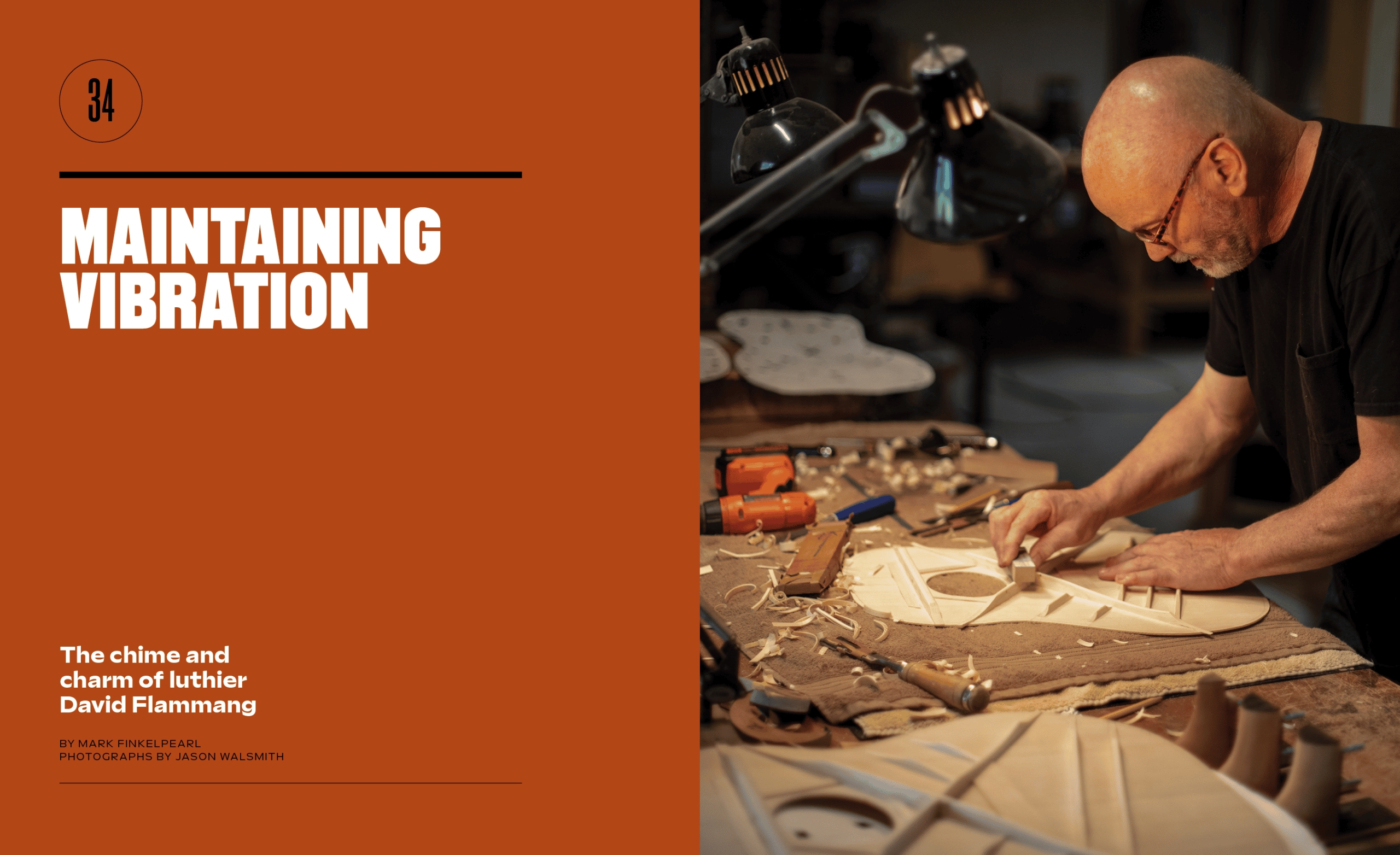 Jazz & fusionWhat’s Inside: Fretboard Journal 61Fretboard Journal
 Jazz & fusionOnce You Play Jazz Chords Like THIS, Everything Sounds BetterJens Larsen — jazz guitar lessons
 Jazz & fusionHow Ronnie Wood found his voice as a guitaristGuitar World
 Jazz & fusionThe Best Left-Hand Technique For Chords 😎 #jazzchordsThe Best Left-Hand Technique For Chords 😎 #jazzchords Jazz chords often have difficult stretches, but most of getting better at them is how you position your left hand. That part is easy to overlook. Which chord is the hardest stretch for you? Get the PDF on Patreon: https://www.patreon.com/posts/117204729Jens Larsen (YouTube)