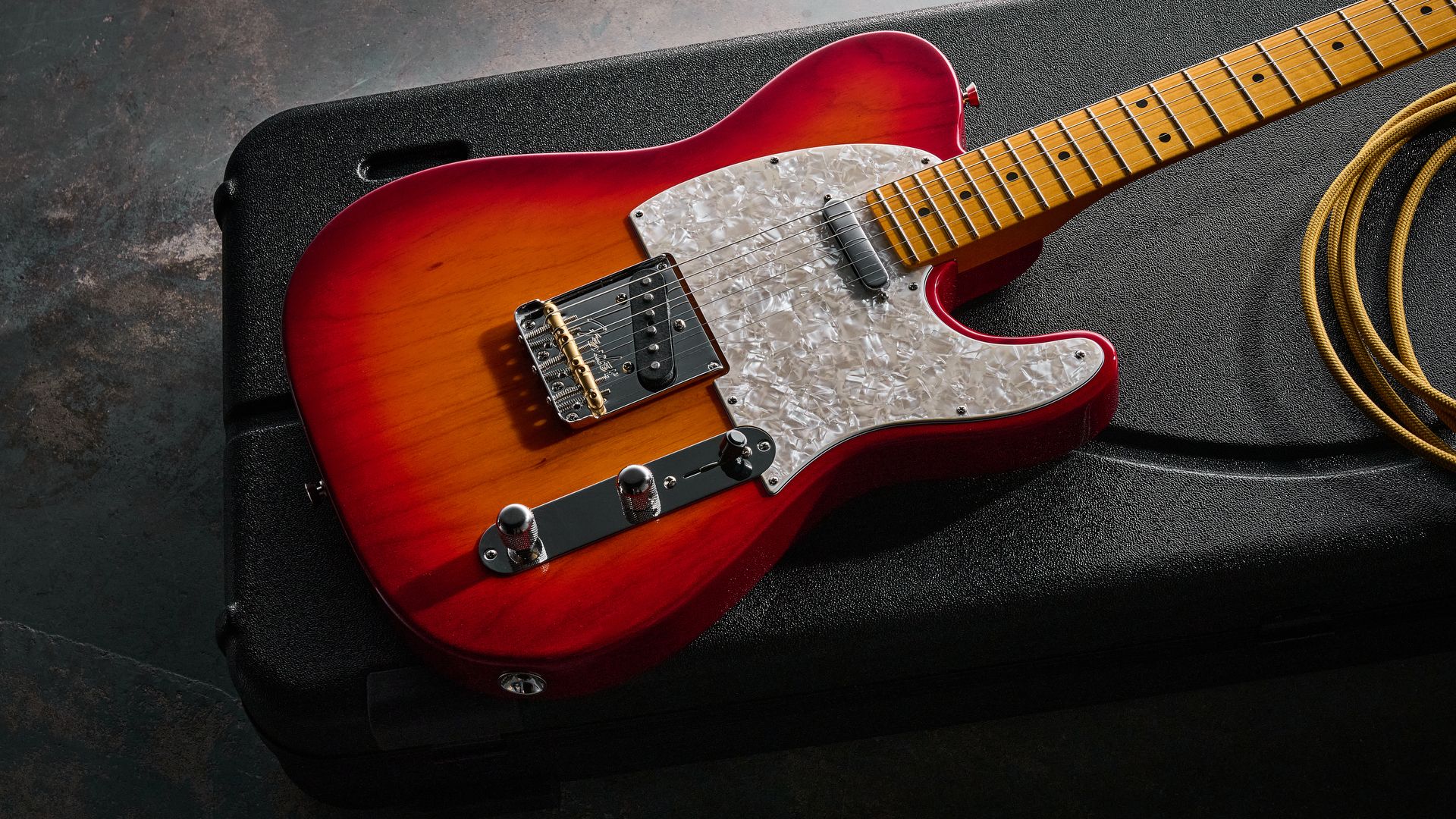
Fender American Professional Telecaster review: "Does exactly what I want a Tele to do"
17 November 2026 · Source: Guitar World
Fender's American Professional line mixes classic feel with modern appointments, and its latest iteration comes with impactful changes
What is it?
Initially released as the Broadcaster in 1950 and renamed the Telecaster (with a few 'Nocasters' in between) in 1951 following a lawsuit from Gretsch, the Fender Telecaster has been in continuous production ever since. Its long 70 years have seen it become associated with a raft of famous names, from Keith Richards and his open-tuned riffs to Prince’s infamous solo on that cover of While My Guitar Gently Weeps. And, of course, when it comes to country music, the Telecaster is the conventional weapon of choice.
In short, it is a straightforward and versatile instrument, making it an often-chosen tool for many professional musicians, whether that’s world-conquering country artists or those working hard at weekend function gigs. Particularly for the latter, what's needed is a professional-grade instrument that can be happily dragged round any venue without a worry. That’s where Fender’s American Professional range comes in.
(Image credit: Lucy Robinson)Currently sitting on the second rung of Fender’s American-made instruments (just above the American Professional Classic), these are instruments that are designed to be workhorses. Blending a traditional feel with a selection of well-chosen modern features, it’s nothing too fancy, but high quality all the same.
The 2026 American Professional follows on from the American Professional II. You can think of it as the American Professional III, but Fender has reverted to the older naming convention of keeping the series name the same while updating the spec.
The main differences for 2026 center around the tweaked neck shape, a redesigned bridge, and some new pickups. Let’s see if it lives up to the Telecaster legacy.
Specs
(Image credit: Lucy Robinson)Launch price: $1,799 | £1,799 | €2,099 Made: USA Type: Six-string electric guitar Body: Alder Neck: Maple, Deep C Fingerboard: Rosewood Scale length: 25.5”/647mm Nut/width: 43mm Frets: 22, narrow, tall Hardware: Classic Gear Telecaster bridge, 3 brass saddles, compensated Electrics: V Mod III Telecaster pickups, 3-way selector, volume, tone, push-push switch puts pickups into series mode String spacing at bridge: 55mm Weight: 7.2lb/3.3kg Left-handed options: No Finishes: Natural - ash body, rosewood/maple neck; Butterscotch Blonde - ash body, maple neck; Aged Cherry Burst - ash body, maple neck (as reviewed); Black - alder body, maple/rosewood neck; 3 Color Sunburst - alder body, maple/rosewood neck; Oxblood - alder body, maple/rosewood neck; Dark Night - alder body, rosewood neck Cases: Fender Deluxe Modded hard case Contact: Fender Build quality
(Image credit: Lucy Robinson)Build quality rating: ★★★★½
The first thing to mention is that this Aged Cherry Burst is stunning. The ash body on this particular model sports a lovely grain that the transparent nature of the finish shows off well.
A lacquered maple fretboard sits atop the Tele’s usual maple neck with a smooth satin finish, and a bone nut at the top. As you would expect at this price point ($1,799) and for an instrument aimed at the professional, the narrow, tall frets are finished nicely.
So far, so good, but also kind of normal for a Telecaster. Where things start to get interesting is at the bridge, as it has been updated to Fender’s Classic Gear Tele bridge with three compensated brass saddles.
(Image credit: Lucy Robinson)A big change here is the recessed saddle screws (the same ones used to adjust the action). No longer do we have to worry about the discomfort of these screws digging into our hand while we play. It might not seem like headline news, but for those of us who play day in and day out, it will be an appreciated one, particularly if you like a low action where the saddle would be sitting lower down the screws thread.
Like the previous American Professional II range, the bridge can have the strings either top-loaded or string-through - a nice option to have. Top-loaded results in subtly less string tension and, some would argue, a slightly less resonant/spanky tone.
While we are talking about seemingly subtle but actually genuinely useful spec upgrades, the neck plate on the 2026 American Professional also features a micro-tilt adjustment. This is an underrated '70s Fender developmen that has found favor again in select models (including the Acoustasonic models) that allows users to change the angle of the neck (a feature that can help tweak string action) by loosening two of the neck bolts and using a small Allen key, without needing to go to the bother of removing it completely to place a shim at the heel joint. I think it's a really useful additional tool to have in pursuit of the perfect action for your preference.
Not that I need to worry about that too much here, as the action is a medium-low 1.5mm on the low E and 1.25mm on the high E.
(Image credit: Lucy Robinson)The new V Mod III Tele pickups also feature a push-push control that activates both pickups in series mode. That control, however, feels quite spongy in use, giving an impression that is a little less than premium.
Our test guitar took a long time to settle out of the box, but tuning then remained stable once it had done so, and the tuners themselves do a good job, but they aren't the most reactive tuners I've ever used on a US Fender.
Playability
(Image credit: Lucy Robinson)Playability rating: ★★★★½
Alternate-picked country runs come off nicely
Given that it is a Telecaster, I can’t help but run through my admittedly limited repertoire of country licks. In doing so, the guitar feels pretty smooth.
Alternate-picked country runs come off nicely thanks to the aforementioned medium-low action, and legato feels equally as comfortable.
Its 9.5” radius has a more traditional feel (although not as vintage as a 7.25” Fender), which is nice and comfortable when it comes to chords, but it doesn’t quite lend itself to blazing-fast three-note-per-string runs. But then again, that is not what you would expect on this type of guitar.
In the same vein, I would not expect to see a super-shreddy, wizard-thin neck on a Telecaster, and so this American Professional series nods towards a more classic spec with a Deep C profile.
(Image credit: Lucy Robinson)It's a good middle ground between thin and meatier fare. Not as chunky as the neck on my Custom Shop ‘51 Tele, but noticeably bigger than the Modern C to D profile on my American Elite Stratocaster.
I enjoy the more connected feel that a fuller neck profile gives, and the Deep C here ticks that box.
Bends and vibrato come off with ease thanks to the tall nature of the frets. I’ve always found bends a little easier still on jumbo frets, but the upside of these narrow frets is more accurate intonation. Either way, this is definitely in the land of preference, and a fairly standard appointment that a lot of players will feel immediately at home on.
There is no belly carve at the rear of the body here like the Elite and more recent Ultra II Tele models, and without that contour, those with a smaller frame can sometimes find Telecasters a little unwieldy under the strumming arm.
This isn’t the case at the heel joint, however, as here it is sculpted to allow easier access to those higher frets.
(Image credit: Lucy Robinson)Another considerate feature for real-world Tele enhancement are the knurled control knobs, which allow for easier grip, as well as the aforementioned push-push function which, despite my earlier complaint, is much preferable to the push-pull often featured on other guitars.
I’ve been on many a sweaty stage where it's tricky to get a grip on the control to pull it away from the guitar fast enough to be useful, and even without that consideration, it is still a much more involved movement than a quick push.
Sounds
(Image credit: Lucy Robinson)Sounds rating: ★★★★½
As you would expect given that this is a Telecaster, the new V Mod III pickups are kicking out a good amount of high-mid presence, whilst keeping the low end very controlled.
Playing through my Fender Hot Rod Deluxe IV, the bridge pickup accentuates the highs in a way that results in an ice-picky sound on sparkling cleans. It’s not so offensive as to be avoided, though, as it suits those clean country lead lines that really need that cut.
Where it starts excelling in a more universal way is when I apply some gain via my Browne Amplification Ethane dual overdrive pedal. With light drive, the slight compression tames those highs whilst remaining dynamic and reacting well to pick attack, and as the gain increases, things stay clear and articulate thanks to those cutting highs and a conservative low end.
(Image credit: Lucy Robinson)On the neck pickup, there is a slight increase in lows, in addition to some high-end roll-off, making for a wonderfully glassy sound for cleans and a rewardingly warm drive.
By a slight increase in low end, I don’t mean there is a lot, but this is exactly what I want from a Tele. There's biting midrange and a low end that never gets out of control.
The middle position presents a good mix of the two, adding more cut to that neck sound. Interestingly, the push-push control sounds like it is activating both pickups in series mode in all positions, rather than just position two as stated in Fender's blurb about the guitar.
There's biting midrange and a low end that never gets out of control
The thing is, I actually prefer this. It is only doing one thing, so it may as well be accessible from all three positions rather than having to switch to position two to use it.
Either way, it results in an increased output and a ton of low mids, which is great for some girthy rock power chords. On the flip side, those frequencies come with a bit more mud, so if you are after some high-end articulation, it is best avoided.
Verdict
(Image credit: Lucy Robinson)As a workhorse Telecaster, the American Professional certainly ticks most of the boxes with only a few minor things to gripe about.
It plays well and boasts some well-thought-out features that are obviously aimed at the working guitarist. And most importantly, the V Mod III pickups sound great, offering plenty of mid-range bite with the tight low end you would expect from a Telecaster.
It's worth noting the $100 price drop
And it's worth noting the $100 price drop when compared to the outgoing American Professional II series, too.
Guitar World verdict: It’s a Telecaster doing Telecaster tones, with some classic specs alongside a few modern features aimed at the regular gigging player. In short, it sounds great, plays well, and looks stunning.
Ratings scorecardTest
Results
Score
Build quality
A classic Tele formula which looks great.
★★★★½
Playability
It may not be for the shredders, but speedy country runs and bends come off with ease.
★★★★½
Sounds
The new pickups deliver exactly the sort of high end punch and low end control that I want from a Tele, but it is a touch muddy in series mode.
★★★★½
Overall
A great guitar that, does exactly what you want a Tele to do.
★★★★½
Also try
Fender American Ultra II Telecaster $2,299 | £2,209 | €2,569
The Ultra II range looks to add all the modern accouterments to the Fender lineup. For the Telecaster, this means body contours, a 10-14" compound radius, a six-saddle bridge, and noiseless pickups, to name a few highlights.
Read more: Fender American Ultra II Telecaster review
Fender American Vintage II 1951 Telecaster $2,649 | £2,219 | €2,579
For those who appreciate a vintage spec, the American Vintage II 1951 Telecaster is worth a look. The vintage-correct appointments include a 7.25" radius, a chunky U-shaped neck, and Pure Vintage '51 pickups.
Read more: Fender American Vintage II 1951 Telecaster review
Fender Player II Telecaster $949 | £799 | €929
Fender excels at providing a guitar for every budget. If you are looking for something below $1,000 that will be a workhorse, the Mexican-made Player II Tele could fit the bill. In short, it does the Telecaster thing, but at a lower price.
Read more: Fender Player II Telecaster review
Hands-on videos
Fender
Peach Guitars
More in this topic
 Gear & luthieryMichael J. Fox thinks he knows what happened to the ‘Back to the Future’ Gibson ES-345Guitar Player
 Gear & luthieryGear Radar December 2026Premier Guitar
 Gear & luthieryI’ve checked out all 77 items in Fender’s Black Friday sale, but it’s the rarities and exclusives that have caught my eyeMusicRadar
 Gear & luthieryWTF is a Synergy amp?It’s the stuff of fantasy for tone-chasing guitarists – a tube amp that lets you remove the preamp and slot another one straight in. A single amp chassis that can be transformed from a Fender into a Peavey 6505, a Dumble clone, an Engl… it’d be quite something. This is the idea behind Synergy Amps, part of the larger Boutique Amps Distribution roster operating out of California. Have they nailed it with the Synergy SYN-20IR Amp Head? Read our review https://www.guitarworld.com/gear/guitar-amp-heGuitar World (YouTube)