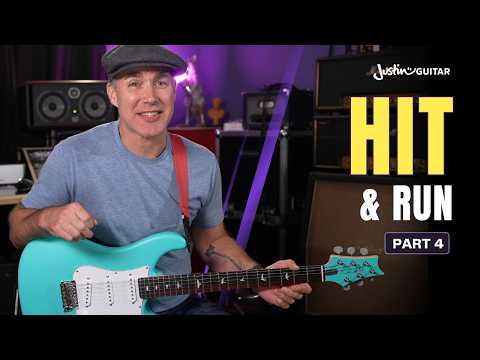
Chord to LEAD and back - The Hit and Run!
24 October 2026 · Source: JustinGuitar (YouTube)
🎸 Join the free Mix Rhythm & Lead mini-course to download your Guitar Pro files and PDFs: https://www.justinguitar.com/mix-p4 💡 Play a bass note, hit a chord, then add a little lead lick. In Part 4, I'll show you the Hit and Run approach to mixing rhythm and lead without losing your place. We'll start with bass on beat 1, a short chord on beat 2, and two beats of lead. Get comfortable on one A chord, then take the idea through a 12-bar blues. I'll also show you how to let the lick finish on be
Video transcriptauto-generated captions · EN · RU
Click a timecode to jump to that moment in the video
Heat.
Жара. Жара. Жара.
Heat.
Эй, как дела? Джастин вернулся с тобой на другой урок, где мы проверяем разные вещи. подходы к смешиванию ритма и свинца. Как ты, наверное, слышишь, у меня сейчас горло испорчено. Но я пытаюсь взломать.
Heat.
В любом случае, на этом уроке мы проверим небольшую технику, которую я называю Беги и беги, где мы ударяем аккорд, А потом мы убегаем с какими-то зацепками. На самом деле, это довольно крутой трюк. Мы будем играть на басовой ноте в первом бите,
Hey, how you doing?
Чип на аккорде по биту два, а потом у нас есть два удара свинцовой линии. Это первый шаг на этом пути. Но тогда мы также посмотрим, что произойдет, если мы позволим этому руководить. run run пробежать немного, потому что вы вроде как узнали это раньше, если вы были Делаю серию.
Justin back with you for another lesson where we're checking out different
Это для большинства людей немного проще, чем последний урок, где мы добры. Немного дальше от куска. Этот действительно отличный, чтобы попрактиковаться, потому что он заставляет вас убедиться, что что вы понимаете ритм лизаний, которые вы играете, потому что перерывы
approaches to mixing up rhythm and lead.
довольно короткие. Это дает вам возможность работать в этих маленьких лайках и, возможно, перемещаться между ними. Различные части шеи гитары тоже. Он работает для всех аккордов. Для меня это звучит немного повторяемо, если вы сделали то же самое, что и я.
As you can probably hear, I've got a pretty ruined uh throat at the moment,
Вступление там, где я делаю это как действительно последовательно. Это своего рода техника, где вы с большей вероятностью смешиваете ее с другими подходит к смешиванию свинца и ритма вместе, Это отлично подходит для практики только по-своему.
but I'm trying to crack on.
Итак, давайте перейдем к крупным планом и посмотрим. Начните с обычного аккорда. Не обязательно быть семь или что-то в этом роде. Обычный А. Мы сыграем в "Б". Обычно я играю басовую ноту большим пальцем и аккордом пальцами,
Anyway, in this lesson, we're going to be checking out a little technique I call the
но вы определенно можете делать это с обычной формой аккорда, Но важно, чтобы ты играл на басовой ноте и аккорде. А аккорд очень плотный. Так что, на самом деле, ух-пальцы едва нажимают на ниточки достаточно, чтобы Но когда вы идете на струм,
hit and run, which is where we hit a chord,
Вы просто сжимаете пальцы вниз, а затем снова поднимаете их. Этого достаточно, чтобы получить довольно чистый аккорд. Хотя я часто на самом деле использую эмм кирку и руку внешнюю ладонь, а также Отключение как своего рода дополнительная мера безопасности.
and then we run away with some lead stuff.
Итак, первое, что вы хотите сделать, это просто пойти 1 2 3 4 басовый аккорд 3 4 1 2 3 4 басовый аккорд 3 4 затем лизание 1 2 3 и 4 1 2 3 и 4. Сделай это по-настоящему просто.
Now, it's actually a pretty cool trick here.
Супер пушистый. Теперь, просто оставаясь на одном аккорде и привыкая к ритму прежде всего. Пытаюсь найти то, что у тебя есть, что такое милое и короткое. Вы можете обнаружить, что у вас есть грузы. Вы можете обнаружить, что у вас их очень мало.
We're going to be playing the bass note on beat one,
Если у вас их немного, возможно, вам нужно попытаться немного расширить свой словарный запас и Начните думать о таких милых простых маленьких лизающих идеях, потому что очень часто, если вы смешиваете ритм и лидируете, У тебя не так много времени, чтобы сделать соло.
a chip on the chord on beat two, and then we've got two beats of lead line.
Итак, вам нужны эти ночные короткие краткие и лаконичные лайки, которые имеют что-то для Скажем, недолго. Итак, я бы рекомендовал вам потратить много времени только на один аккорд прежде всего и По-настоящему захватить его. Как только вы почувствуете себя уверенным в этом,
So that's the first step along the way.
Вы готовы начать переход к блюзу 12 бар. Предлагаю тебе остаться в ключе от А. Как вы знаете, когда мы переходим к аккорду "Д" и "Е" в блюзе 12 бар, Ты можешь держаться вокруг пентатоника А минор.
But then we're going to have also have a look at what happens if we let that lead
или вы можете перемещать вещи, которые вы собираетесь играть, чтобы следовать по аккордам. Какая из тех вещей, которые вы делаете, будет зависеть от того, где вы находитесь на гитаре путешествие. В начале, очевидно, легче просто играть в лилики, что вы знаете, что
run run run over a little bit cuz you've kind of learned this before if you've been
работа с минорной пентатоники, которая подходит для всех аккордов. Чем продвинутее вы становитесь гитаристом, чем больше вы, вероятно, будете думать о аккорде конкретные лайки и изложение
doing the series.
Гармония. Конечно, вы могли бы делать такие вещи, как использование шести, которые мы рассмотрели Ранее в этой небольшой серии. Если вы следили за моим курсом погружения в блюз, эх, вы определенно будете поражены э-э, нацелившись на третий аккорд и получить
This is for most people a little bit easier uh than the last lesson where we're kind
Немного более конкретный аккорд. Так что, э-э, вы можете пойти на такие подходы, если вы немного немного дальше по пути. Давайте посмотрим на своего рода базовую версию 12-барного блюза. Опять же, держать ритм очень простым. И если ты не можешь держать ритм простым,
of going a little bit further off piece.
нет смысла пытаться идти впереди себя и делать более сложные Начните с чистого листа, умейте это делать. Конечно, ты можешь начать. становится действительно сложным с вашим ритмом, с вашими лизами и вашими линиями,
This one's a really great one just to practice because it forces you to make sure
Но вы должны помнить, чтобы быть в состоянии сохранить его во времени. Если ты не можешь быть твердым, когда возвращаешься во времени, вы хотите упростить его снова и вернуться к поддержанию ритма простым и Идея проста и вовремя.
that you understand the rhythm of the licks that you're playing because the breaks
Никто не хочет слушать твои причудливые вещи, если ты не играешь вовремя. Это очень важно. Так или иначе, 12-барный блюз в ключе от А. Такая же идея, настоящие простые лайки. 3 4 1 2 Вы ставите
are quite short.
Повернись, если хочешь. Как правило, в последних парочках, Вы собираетесь сделать поворот, потому что снова это подчеркивает, Разбивает монотонность всегда играть эту бас-аккорд. Как я уже говорил, не всегда хочется делать то же самое.
It gives you a chance to work in those little licks and maybe be moving between
Потому что он может начать чувствовать себя немного монотонно. Как упражнение, это фантастика, но как спектакль, Вы, вероятно, хотите немного изменить ситуацию. Итак, кое-что, что мы рассмотрели ранее в ходе курса, это то, что произойдет, если вы продлите Линия за баром.
different parts of the guitar neck as well.
Потому что здесь мы снова играем на басу в бит один, аккорд на бит 2, но ты не всегда хочешь играть эту басовую ноту бить один. И, к счастью для нас, этой идеей довольно просто манипулировать потому что вы Просто оставь бас и сыграй аккорд на бит 2.
It works for all of the chords.
И это дает вам шанс закончить свою линию, довольно часто играя в корневая нота, как вы знаете или любая другая заметка на самом деле, Но заканчивая лизание на бит один, Возвращение к аккорду на биту 2. Бит 2 и 4, когда вы играете блюз или любую музыку на самом деле
It for me it does sound a little bit repetitive if you did it the same as I did in
называется backbeat, где вы получаете что 1 2 и 3 и 4, а также 1 2 и 3. 2. Это где барабанщик будет играть snare drum. Так что, это действительно отличный удар акцента, потому что он действительно держит вас. Заперт в кармане. Особенно если вы играете самостоятельно,
the intro there where I'm doing it like really consistently.
Это даст любому, кто слушает вас, хорошее представление о том, где вы находитесь в это время. Так что, давайте немного пойдем. Итак, мы вернемся к тому, чтобы просто играть на одном аккорде А. но мы посмотрим на расширение этих линий, чтобы лизание закончилось по биту
This is sort of technique where you're more likely to mix it in with other
Один, а потом мы просто будем играть аккорд на второй бит. 3 4 1 2 3 4 1 2 Теперь,
approaches uh to mixing lead and rhythm together,
Здесь много разных идей, к которым я прикасаюсь. Многие из них будут немного экспериментировать. И, как я и предполагал, правда такого рода шаблонов заключается в том, что вы собираетесь Использовать его среди прочего. Я чем больше я делаю это сейчас на этом уроке, что начинает
but this is it. It's it's great for practicing just on its own kind of strictly.
Становится немного ритмично устаревшим. Но эта идея играть аккорд, бас, удар аккорда или чипа, а затем переходит в немного свинца, а затем возвращается Опять же, это действительно фантастическое умение развиваться.
So, let's get to a closeup and check it out.
Вы можете использовать его в большинстве стилей, и потому что он длится только для одного бара, и у него есть то, что Акцент на бит 2, он очень универсален. Работает в соул, работает в блюзе, работает даже в роке и поп-музыке.
Start here with a um just a regular A chord.
Может быть, не столько джаза и фолка, но как любой из этих родственных стилей, основанных на от блюзового типа фундамента. Вы обнаружите, что такая техника действительно полезна. И я не могу достаточно подчеркнуть важность понимания ритма Линии, в которые вы играете.
Doesn't need to be a seven or anything like that.
Так ты понимаешь, сколько ударов стоит линия? Что такое ритмические подразделения. Это четвертные ноты, восьмые ноты, Что ты чувствуешь? Вы определенно можете поиграть с ним и начать смешивать вещи. И я называю это немного растягиванием времени, ускорением и замедлением.
Just a regular A.
немного вниз, как лист падает, где он вроде как ускоряется, когда он движется along. Такое чувство может быть крутым, но вы не можете начать играть с этим, если вы действительно не можете просто остаться во времени и Играть простые лайки.
We're going to play the B.
Ну, и если ты в чем-то новичок в таких вещах, Пожалуйста, просто сделайте это простым, чтобы сделать, Вы знаете, 1 2 3 4 1 2 3 эти маленькие B3 и 4 1 или 3 и 4 и 1 2 3 и Четыре и один. Я пытался получить зацепку.
Now, I usually play the bass note with my thumb and the chord with the fingers,
Как я уже сказал, есть много маленьких обречений, которые вы можете добавить. Вы можете играть с нотой, которую вы заканчиваете. Я пытался закончить на корне довольно часто, потому что это просто для того, чтобы прояснить,
but you can definitely be doing it uh with a regular chord form,
мы заканчиваем линию на корне, а затем возвращаемся к аккорду, Но тебе не нужно заканчивать на этом, Конечно. Я думаю, что вы найдете это очень полезный инструмент. Надеюсь, вам до сих пор понравилась эта серия.
too. But what's important is that you play the bass note and then the chord.
Если у вас есть какие-либо конкретные проблемы с смешиванием аккорда и вашего свинца и Ваш ритм, дайте мне знать в комментариях. Я попробую их проверить. Я пытаюсь ответить как можно больше комментариев. На сайте будет несколько PDF некоторых профилей гитары, как обычно.
And the chord is very tight.
Но я думаю, что у меня кончается пар с горлом. Он становится довольно квасным. На самом деле, у меня сейчас очень плохой теннисный локоть. Я почти на пределе своей игры. Сейчас я могу делать только 10-15 минут в день. Это отстой.
So, you actually the the uh fingers are hardly pressing on the strings enough to
Я определенно переучился и совмещал это с переутомлением в спортзале. Не будь таким, как я, и сделай это. Надеюсь, у вас будет фантастический отдых и вы наслаждаетесь этим уроком. Эта небольшая серия. Увидимся очень скоро. Береги себя. До свидания.
mute them. But as you go for the strum,
—
you just press the fingers down and then lift them off again.
—
That's enough to get a pretty clean chord.
—
Although I do often actually use the um the pick and hand outer palm as well
—
to mute just as kind of extra safety measure.
—
So, the first thing you want to think about doing is just going 1 2 3 4
—
bass chord 3 4 1 2 3
—
4 bass chord 3 4 then a lick 1 2
—
3 and 4 1 2 3 and four.
—
Keep it real simple.
—
Whoops. Super fluffy.
—
Now, just staying on the one chord and getting used to the rhythm first of all and
—
trying to find what licks you've got that are nice and short like that.
—
You might find that you got loads.
—
You might find that you've got very few.
—
If you've got few, maybe you need to try and expand your vocabulary a little bit and
—
start to think about about those kind of nice simple little lick ideas because very
—
often again, if you're mixing together rhythm and lead,
—
you don't have like a really long time to do a solo.
—
So, you need these night nice short uh concise licks that have something to
—
say, aren't going on too long.
—
So, I'd recommend you spend a good amount of time just on one chord first of all and
—
really get a grip on it.
—
Once you feel confident with that,
—
you're ready to start moving on to a 12 bar blues.
—
Suggest you stay in the key of A.
—
As you know, when we move to the D chord and the E chord in a 12 bar blues,
—
you can stick around the A minor pentatonic for the whole thing,
—
or you can move the things that you're going to play to follow along the chords.
—
Which one of those things you do would depend on where you're at on your guitar
—
journey.
—
At the beginning, it's obviously easier to just be playing licks that you know that
—
work from the minor pentatonic that kind of fit over all the chords.
—
The more advanced you get as a guitar player,
—
the more you'll probably be thinking about chord specific licks and outlining the
—
harmony. Of course, you could be doing things like using the six that we've covered
—
previously in this little series.
—
Uh if you've been following along with my blues immersion course,
—
uh you'll definitely be hit with uh targeting the third of the chord and getting a
—
little bit more chord specific.
—
So, uh you might want to be uh taking those kind of approaches if you're a little
—
bit further along the way.
—
Let's look at a kind of a very basic version of the 12 bar blues.
—
Again, keeping the rhythm real simple.
—
And if you can't keep the rhythm simple,
—
there's no point in trying to go get ahead of yourself and do more complicated
—
stuff, right? So, start easy, be able to do it.
—
Of course, you can start, you know,
—
getting really complex with your rhythm and with your licks and your lines,
—
but you got to remember to be able to keep it in time first.
—
If you can't be solid when you come back in time,
—
you want to simplify it down again and go back to keeping the rhythm simple and the
—
idea simple and staying in time.
—
No one wants to hear your fancy stuff if you're not playing in time,
—
right? It's really crucial.
—
Anyway, 12 bar blues in the key of A.
—
Same sort of idea, real simple licks.
—
3 4 1 2 You put a
—
turn around in if you want.
—
So, usually in that last couple of bars,
—
you're going to put a turnaround because again that highlights it,
—
breaks up the monotony of always playing that bass chord thing.
—
Now, as I mentioned earlier, you don't always want to be doing it exactly the same
—
because it can start to feel a little bit monotonous.
—
As an exercise, it's fantastic, but as a performance thing,
—
you you probably do want to be kind of varying things up a little bit.
—
Now, something we've covered earlier on in the course is what happens if you extend
—
a line beyond the bar.
—
Because here again, we're playing the bass on beat one,
—
the chord on beat two, but you don't always want to be playing that bass note on
—
beat one. And luckily for us, this idea is quite simple to manipulate because you
—
just leave off the bass and play the chord on beat two.
—
And that gives you the chance to finish your lead line by quite commonly playing the
—
root note as you know or any other note really,
—
but finishing the lick on beat one,
—
coming back to the chord on beat two.
—
The beat two and four when you're playing a blues or any sort of music really is
—
referred to as the backbeat where you get that 1 2 and 3 and four and 1 2 and 3 and
—
2. It's it's where the drummer would play the snare drum.
—
So, it's a really great beat to be accenting because it really kind of keeps you
—
locked into the pocket.
—
Particularly if you're playing on your own,
—
it'll give anyone listening to you a good sense of where you are in the time.
—
So, let's have a little go.
—
So, we're going to go back to just playing on the one chord on the A chord,
—
but we'll look at extending those lines so that the lick is going to finish on beat
—
one, and then we're just going to be playing the chord on beat two.
—
3 4 1 2 3
—
4 1 2 Now,
—
there's a lot of different ideas here that I'm touching on.
—
A lot of it's going to be a bit of experimentation.
—
And as I suggested, the the truth of this kind of pattern is that you're going to
—
use it in amongst other things.
—
I I the more I'm doing it now in this lesson going that starts to
—
become a little bit rhythmically stale.
—
But this idea of playing a chord, a bass,
—
a chord hit or a chip, and then moving into a bit of lead stuff and then coming back
—
again, it really is a fantastic skill to develop.
—
You can use it in most styles and because it lasts only for one bar and it has that
—
uh accent on beat two, it's very versatile.
—
Works in soul, works in blues, works in even rock and pop to some extent.
—
Maybe not so much jazz and folk, but like any of these kind of related styles based
—
off of a bluesy kind of foundation.
—
You're going to find this kind of technique is a really really useful one.
—
And I can't emphasize enough the importance of understanding the rhythm
—
of the lead lines that you play.
—
So you understand how many beats a line goes for?
—
What the rhythmic subdivisions are.
—
Is it quarter notes, eighth notes,
—
triplets? What's how's it feel?
—
You can definitely play around with it and start to mix stuff up.
—
And I I kind of call it stretching the time a little bit and speeding up and slowing
—
down a little bit like a leaf falling where it kind of speeds up as it's moving
—
along. That kind of feeling is can be cool,
—
but you can't start playing with that if you can't actually just stay in time and
—
play simple licks.
—
Well, and if you're in any way new to this sort of stuff,
—
please just keep it simple to be doing,
—
you know, 1 2 3 4 1 2
—
3 this little B 3 and 4
—
1 or 3 and 4 and 1 2 3 and
—
four and one.
—
I tried to get a lead line.
—
Now, as I said, there's lots of little doodle dooms that you can add in.
—
You can play around with the note that you finish on.
—
I tried to finish on the root quite often because it just to kind of clarify that
—
we're finishing the lead line on the root and then moving back to the chord,
—
but you don't have to finish on that,
—
of course.
—
I think that you're going to find this a really useful little tool.
—
I really hope you've enjoyed this little series so far.
—
If you are having any specific issues with mixing your chord and your your lead and
—
your rhythm, uh, do let me know in the comments.
—
I'll try and check them out.
—
I'm trying to answer as many comments as I can.
—
There'll be some PDF of some guitar profiles as usual over on the website,
—
but I think I'm running out of steam with my throat right now.
—
It's starting to get pretty croaky.
—
I actually also got pretty bad tennis elbow right now.
—
So, I'm almost at the limit of my playing.
—
Uh, I can only find I can do like 10 15 minutes a day at the moment.
—
It's kind of sucks.
—
Uh definitely uh over practicing and combining it with overdoing it at the gym.
—
Terrible idea. So don't be like me and do that.
—
Uh hope you have a fantastic rest of your day and you're enjoying uh this lesson and
—
this little series.
—
And I'll see you for plenty more very soon.
—
You take care.
—
Bye-bye.
—
More in this topic
 Blues, rock & metalJosh Homme on Desert Rock #rockmusic #stonerrockRick Beato (YouTube)
 Blues, rock & metalJustice and Michael McDonald’s new GTA VI song sounds like a yacht rock ode to an ’80s Genesis bangerMusicRadar
 Blues, rock & metalMichael J. Fox, John Mayer and Brad Paisley recreate the iconic Back to the Future guitar sceneGuitar Player
 Blues, rock & metalVan Halen and Patty Smyth? Michael Anthony says it almost happened: “Ed was freaking out”The bassist confirms the Scandal frontwoman — and close friend of Valerie Bertinelli —was among those considered after David Lee Roth’s departureGuitar Player